A theory of the rates of elementary reactions which assumes a special type of equilibrium, having an equilibrium constant K
‡, to exist between reactants and activated complexes. According to this theory the rate constant is given by:
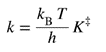
where
kB is the Boltzmann constant and
h is the Planck constant. The rate constant can also be expressed as:
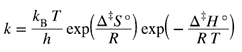
where Δ
‡S°, the entropy of activation, is the standard molar change of entropy when the activated complex is formed from reactants and Δ
‡H°, the enthalpy of activation, is the corresponding standard molar change of enthalpy. The quantities E
a (the energy of activation) and Δ
‡H° are not quite the same, the relationship between them depending on the type of reaction. Also:
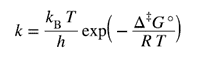
where Δ
‡G°, known as the Gibbs energy of activation, is the standard molar Gibbs energy change for the conversion of reactants into activated complex.
